- Home
- Extruders and Pelletizers
- Case Study: JSW CMP308 Part Life
Doubling Part Life on a JSW CMP308
Premature screw and barrel wear, die freeze-off and nozzle clogging solved as one failure chain

Premature screw and barrel wear, die freeze-off and nozzle clogging solved as one failure chain
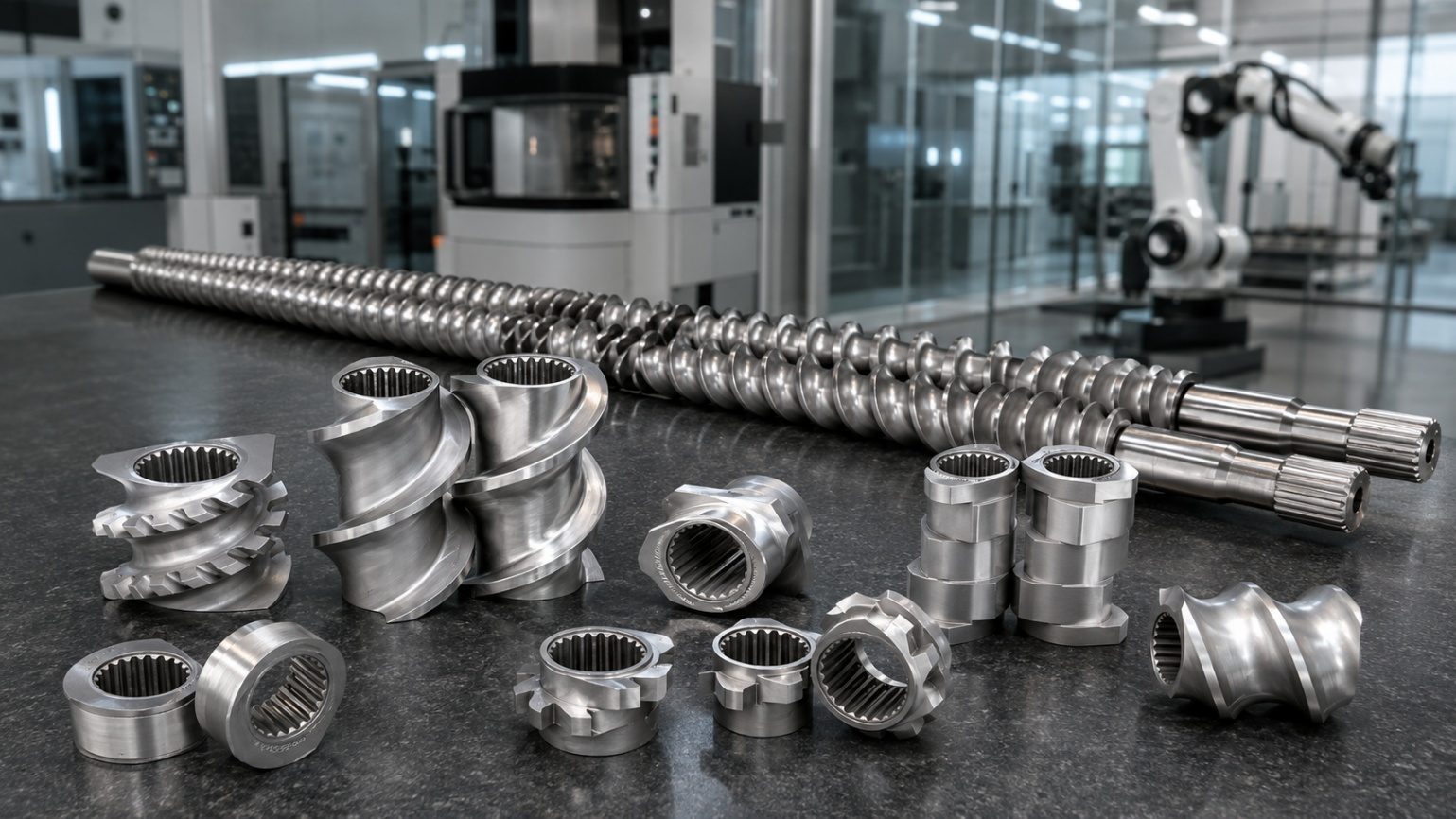
| Customer | Polyolefin production and compounding complex, United States |
|---|---|
| Machine | JSW CMP308 twin-screw extruder with JSW ADC underwater pelletizer |
| Application | Compounding and underwater pelletizing of PP, HDPE and LLDPE |
| Problem | Screw elements and barrel bore wearing out far ahead of expected life; repeated die plate freeze-off and nozzle clogging; escalating repair cost and unplanned downtime |
| UNEW Industries scope | Root cause investigation, reverse engineering, material and geometry upgrade, new manufacture of screw elements, barrels, die plate and knives |
| Result | At least double the original service life on the affected parts; freeze-off and clogging eliminated as a recurring failure mode |
The machine would not hold its parts. Screw elements and the barrel bore wore back long before the end of their expected life, the die plate froze off repeatedly and the nozzles clogged. Every event meant a stop, a strip-down and another repair. The plant had treated it as a maintenance problem for years — replacing the same parts, more and more often, at rising cost.
Parts that fail early and keep failing early are not a maintenance problem. They are a specification problem.
We surveyed the machine as a system: wear mapped position by position along screw and barrel, metallographic sections through worn surfaces, case depth and hardness on the nitride layers, and the die face examined for thermal behavior, nozzle geometry and deposit pattern.
| Finding | What it meant |
|---|---|
| Wear concentrated at defined element positions | Three-body abrasion from mineral filler in the PP compounds, worst in the melting and kneading zones — a duty the original element specification was never selected for |
| Nitrided case too thin for the duty | Good life until the case was breached; then the softer core wore at a multiple of the original rate. Life was falling off a cliff, not shortening |
| Barrel bore wear tracking the elements | Hard filler trapped between element and bore attacked both. New elements in a worn bore wore at the accelerated rate immediately |
| Opened clearance degrading the melt | Lost shear and mixing, less homogeneous melt, unstable melt temperature arriving at the die |
| Die thermal balance marginal | Heat lost from the die face to the water box faster than replaced; outer nozzle rows with the least thermal margin tipped into freeze-off on any drop in melt temperature |
| Nozzle inlet geometry holding material | Dead zones at the nozzle entry parked polymer long enough to degrade — the deposit became the clog, reduced open area and made freeze-off more likely still |
Under-specified wear surfaces → clearance opens → melt becomes unstable → die face loses its thermal margin → outer nozzles freeze off and clog → cut quality suffers, knife and die face are damaged → another repair into a machine whose clearance is still open. Every repair with the same specification put the loop straight back into service.
We reverse engineered the affected parts from the worn originals and the machine interfaces, reproduced the geometry that matters exactly — fits, splines, bore, centre distance, element stacking, interchangeability with the customer's stock — and upgraded the material, the surface and the die thermal package.
| Part | As originally supplied | UNEW Industries solution |
|---|---|---|
| Screw elements | Nitrided hot-work tool steel, one specification for all positions | PM HIP high-alloy tool steel in the abrasive positions; nickel-base hardfacing and tungsten-carbide overlay on the flight lands and crests identified by the wear map; wear package varied by position |
| Barrel | Solid nitrided bore, worn oval and open | Bore restored to original geometry and centre distance and relined with a centrifugally cast bimetallic nickel-base carbide alloy in the wear zones; gas-nitrided bore retained elsewhere |
| Twin screw shafts | Within limits, run-out drifting | Splines, journals and seats re-machined to original fit; straightness and run-out tightened so the new clearance is held under load |
| Die plate | Marginal thermal balance; nozzle land and inlet promoting freeze-off and deposit | Heating channels and insulation rebuilt, thermal short to the water box broken; nozzle land, taper and inlet radius corrected; cutting face carbide-inserted |
| Pelletizer knife | Standard blade, damaged by disturbed cutting | Profile and cutting angle matched to the rebuilt die face; carbide-tipped grade; supplied new and reground |
| Bearing bushes and sealing | Worn, allowing secondary movement | Restored to original clearance and fit so nothing downstream inherits the play |
A replacement part restores the machine to the condition in which it failed. An engineered part changes the condition.
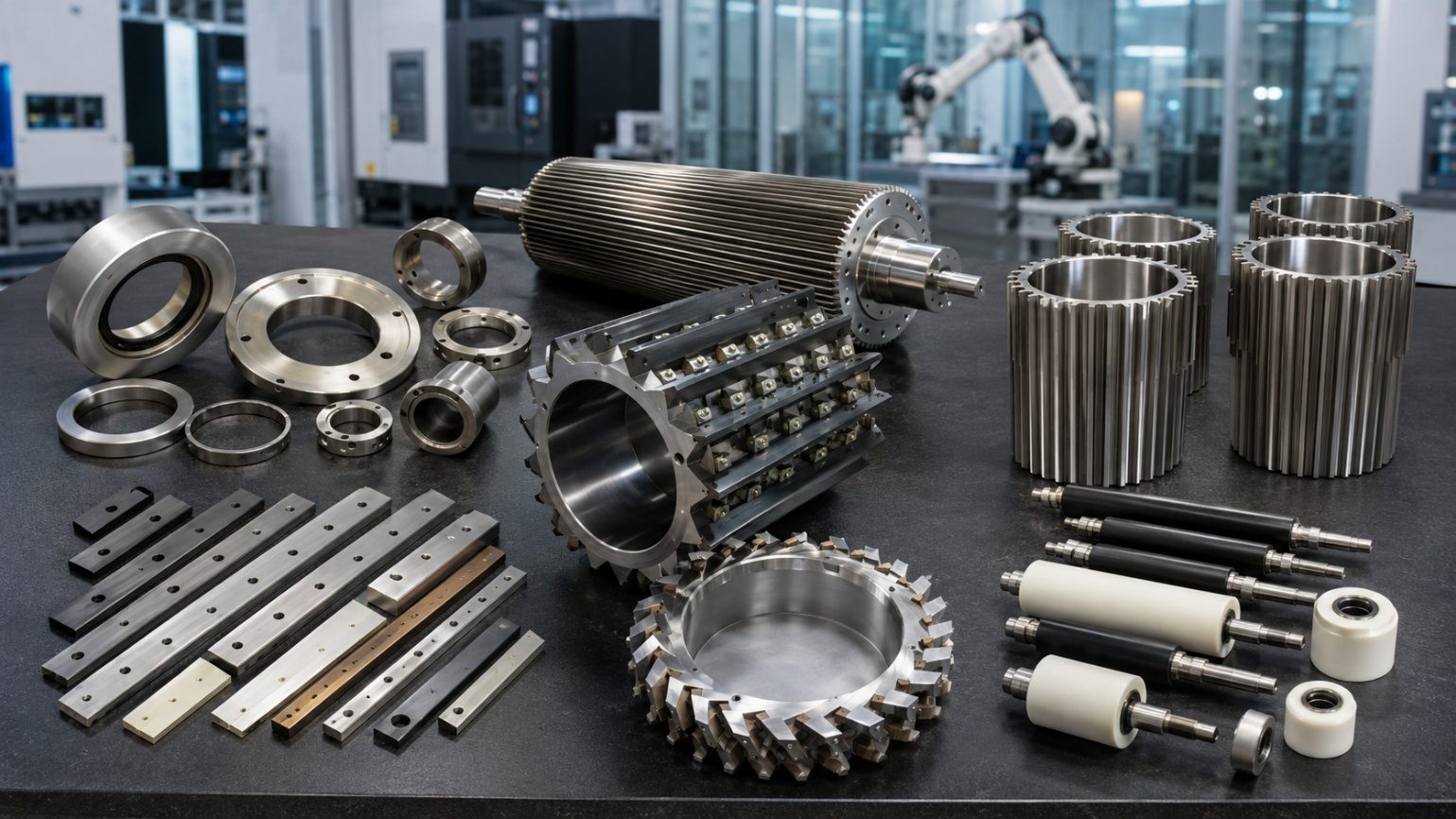
| Application | Specification supplied | Wear mechanism it defeats |
|---|---|---|
| Screw elements — abrasive and filled PP | Powder-metallurgy high-alloy tool steel, HIP consolidated | Hard carbides through the whole body — wear resistance kept as the part wears, not lost when a thin case is breached |
| Flight lands and crests — severe positions | Nickel-base hardfacing and tungsten-carbide overlay | Three-body abrasion at the point of highest contact pressure and velocity |
| Barrel bore — wear zones | Centrifugally cast bimetallic nickel-base carbide alloy | Abrasion and corrosion in the bore; metallurgically bonded liner does not spall under thermal cycling |
| Barrel — general sections | Nitriding steel 1.8550 / 34CrAlNi7, gas-nitrided bore | Standard compounding duty |
| Shafts and couplings | 1.8519 / 42CrMo, through-hardened and nitrided | Torsional fatigue and spline fretting |
| Die plate and cutting face | Tool steel with carbide-inserted face; 17-4 PH where corrosion applies | Face erosion from the knife sweep and pellet water; corrosion at the wetted face |
| Pelletizer knives | Carbide-tipped and hardened tool steel | Edge retention against a hard die face — cutting geometry constant across the campaign |
| Measure | Before | After |
|---|---|---|
| Screw element life | Well short of expected life; replacement driven by flight land loss | At least double the previous service life in the same duty |
| Barrel bore life | Wearing in step with the elements; repeated reboring | At least double; bimetallic liner holding bore and centre distance |
| Die plate freeze-off | Recurring; unplanned stops with a solid die face to clear | Eliminated as a recurring failure mode; thermal margin restored on all nozzle rows |
| Nozzle clogging | Progressive blockage, uneven flow, off-spec pellets | No longer a routine event |
| Pellet quality | Tails, doubles and misshapen pellets during clogging events | Consistent cut, stable across the campaign |
| Knife and die-face damage | Collateral damage after each blockage | Removed at source |
| Repair pattern | Reactive, repeating, escalating in cost | Planned intervals, condition survey, refurbishment where viable |
| Interchangeability | — | All parts interchangeable with the customer's stock and with original components |
The parts did not simply last longer. The failures they used to cause stopped happening — because the loop that produced them was broken, not patched.
The CMP308 is our flagship machine. We hold the complete technical data set for it — shaft and spline systems, screw element and kneading block geometry, element stacking for PP, HDPE and LLDPE service, barrel bore and centre distance, die and cutting-face arrangements, sealing and bearing interfaces — and, from work like this, a documented understanding of the wear and failure mechanisms that actually limit part life on this machine in production. We are not measuring a part for the first time; we know what it should be, how it fails, and what to change.
The same capability is applied to the rest of the JSW CMP and CIM range and to every other extruder and pelletizer platform, of any make, model or age.
UNEW Industries, Inc.
2570 N. First Street, Second Floor, San Jose, CA 95131, USA
Tel. +1-408-892-2364 | info@unewindustries.com | unewindustries.com
UNEW Industries operates an ISO 9001 quality management system. Every part is traceable by serial number from raw material to delivery.
2570 N. First Street, Second Floor, San Jose, CA 95131, USA
Tel. +1-408-892-2364