- Home
- Gas Turbines
- Gas Turbine Capital Parts
Gas Turbine Capital Parts
- Combustion
- Hot gas path
- Compressor
- Rotor — new manufacture to aviation standard

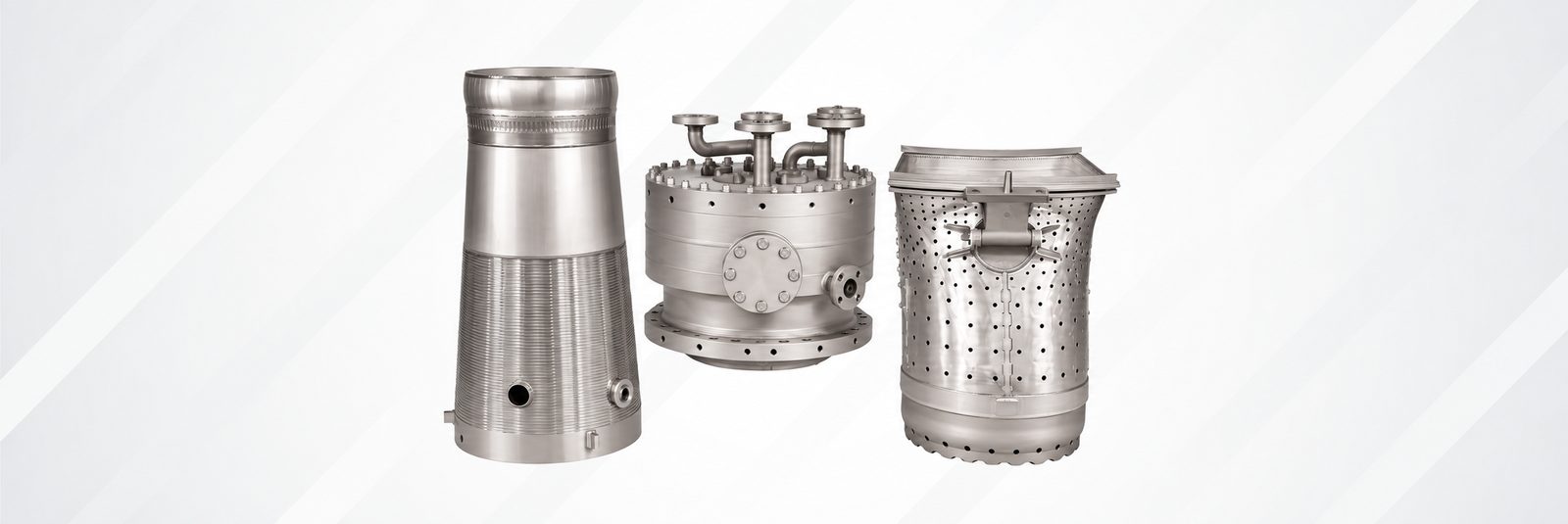
UNEW Industries manufactures the capital parts of heavy-duty gas turbines — the combustion, hot gas path and compressor components that are rolled out at every combustion, hot gas path and major inspection. Every part is produced from UNEW's own technical data, under a UNEW part number, to aviation standard, and meets or exceeds the OEM specification for the position it goes into.
Parts are supplied as complete sets or as single components, for the GE, Siemens, Mitsubishi and Solar fleets and for the ABB / Alstom heritage frames. Any part we do not yet hold is reverse engineered from a used sample.
| System | Components |
|---|---|
| Combustion | Combustion caps and liners, flow sleeves, transition pieces with floating seals, fuel nozzles and end covers, burner assemblies, burner inserts and swirlers, cross-fire tubes and retainers, spark plug and flame detector housings |
| Turbine — rotating | Turbine buckets / blades rows 1 to 4: solid, film-cooled and convection-cooled airfoils, shrouded and free-standing, in equiaxed and directionally solidified superalloys |
| Turbine — stationary | Turbine nozzles / vanes rows 1 to 4 as singlets, doublets and segments; shroud blocks and ring segments with honeycomb or abradable seals; seal rings, retaining rings and spacers |
| Compressor | Inlet guide vanes, compressor rotor blades and stator vanes for all stages, exit guide vanes, variable-vane bushings and levers |
| Rotor | Compressor and turbine wheels, spacers, distance pieces and tie bolts; complete rotors quoted on request |
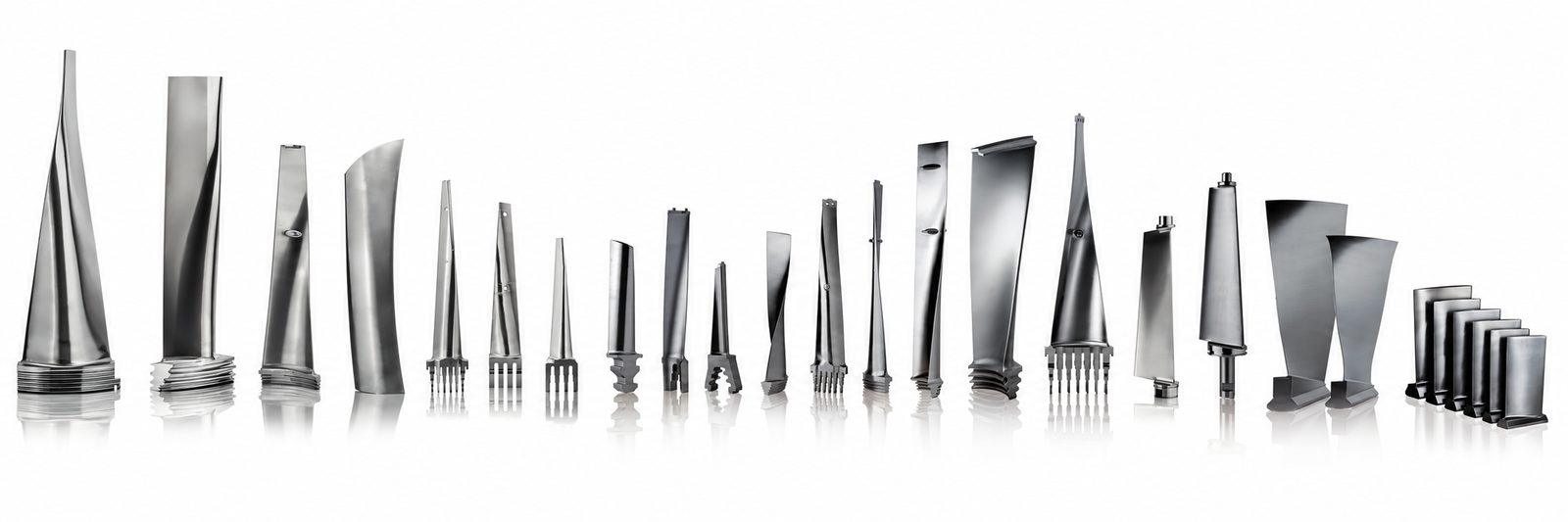
Each part is produced by the process the design calls for. The routing is fixed in the UNEW technical package and is the same on every repeat order.
| Technology | Application |
|---|---|
| Investment casting | Vacuum-melt investment casting of turbine buckets, nozzles and shroud blocks in equiaxed and directionally solidified superalloys; ceramic cores for internal cooling passages; hot isostatic pressing to close casting porosity |
| Forging | Closed-die forging of compressor blades and vanes in titanium and 12% chromium steels; ring and disc forgings for rotor components |
| Sheet-metal fabrication | Combustion liners, caps, flow sleeves and transition pieces formed and welded from nickel-base sheet, with brazed or welded cooling features and floating-seal assemblies |
| Precision machining | 5-axis milling of airfoils and platforms, creep-feed grinding of fir-tree and dovetail roots, EDM of slots and seal grooves, CNC turning of rings and wheels |
| Cooling-hole machining | 5-axis laser and EDM drilling of film-cooling and effusion holes, including shaped holes; every cooled part verified on a calibrated cooling-flow bench |
| Thermal spray and diffusion coatings | Robotic HVOF, VPS and APS application of MCrAlY bond coats and thermal barrier coatings; vapor-phase aluminide of internal passages; erosion coatings for compressor airfoils |
| Joining | Vacuum brazing of tip caps, cover plates and honeycomb; electron-beam and TIG welding of combustion hardware; laser cladding of wear surfaces |
| Heat treatment | Vacuum solution and precipitation heat treatment, coating diffusion cycles and stress relief, with furnace charts retained for each serial |
| Inspection | CMM and 3D optical scanning, fluorescent penetrant and radiographic examination, ultrasonic testing of forgings, metallurgical evaluation, natural-frequency testing and moment weighing of blades |
Base alloys are selected for the position, not for the catalog. Where an OEM has upgraded a position over the life of the frame, we supply the upgraded grade.
| Component | Base alloy | Why |
|---|---|---|
| Turbine buckets / blades | IN738LC, GTD-111 (equiaxed and DS), René 80, MAR-M-247 and equivalent nickel-base superalloys | Creep and thermal-fatigue resistance at metal temperatures above 850 °C; DS grades for rows 1 and 2 on F-class frames |
| Turbine nozzles / vanes | FSX-414 and X-45 cobalt-base; IN939 and IN738LC nickel-base | Cobalt-base for oxidation and hot-corrosion resistance and weld repairability; nickel-base where the OEM design requires higher strength |
| Shroud blocks / ring segments | SS310 and Hastelloy X bodies with IN738 or cobalt-base inner plates; Hastelloy X honeycomb | Thermal cycling of the outer body with a hot-face material matched to the bucket tip |
| Combustion liners, caps, flow sleeves | Hastelloy X, Haynes 230, Nimonic 263 | Formability and weldability of sheet with high-temperature oxidation and low-cycle-fatigue resistance |
| Transition pieces | Nimonic 263, Hastelloy X; cobalt-base L-605 floating seals | Thermal-mechanical fatigue at the aft frame and seal wear at the picture-frame interface |
| Fuel nozzles | 300-series stainless steel bodies, Hastelloy X and IN718 tips | Corrosion resistance on the fuel side with oxidation resistance at the flame tip |
| Compressor blades and vanes | Ti-6Al-4V (front stages); AISI 403, X20Cr13, X22CrMoV12-1, 17-4PH, GTD-450 (rear stages) | Fatigue strength and erosion resistance; 12% chromium and precipitation-hardening steels where the OEM specifies them for temperature or corrosion |
| Wheels, spacers, tie bolts | CrMoV, NiCrMoV, IN706 and IN718 forgings | Fracture toughness and low-cycle-fatigue life at bore and dovetail |
| Coating | Process | Where it is applied |
|---|---|---|
| MCrAlY bond coat (NiCoCrAlY, CoNiCrAlY) | VPS or HVOF, vacuum diffusion cycle | Turbine buckets and nozzles rows 1 to 3, shroud hot faces, combustion hardware under TBC |
| Thermal barrier coating, 7YSZ | APS; dense vertically cracked (DVC) 7YSZ on rows 1 and 2 | Bucket and nozzle airfoils and platforms, combustion liners, transition pieces, shroud blocks |
| Internal aluminide | Vapor-phase (VPA) diffusion aluminide | Internal cooling passages of cooled buckets and nozzles |
| Erosion / corrosion coating | Slurry aluminide-ceramic or HVOF | Compressor blades and vanes at coastal, desert and industrial sites |
| Hardfacing and wear coatings | Laser cladding, HVOF carbide, brazed cobalt-base | Bucket tip shrouds and Z-notches, seal lands, transition-piece seals, nozzle side faces |
Coating thickness, bond strength and microstructure are verified on witness coupons coated with each batch, and the coupon record travels with the parts.
Aviation standard, heavy-duty design. Casting, coating, cooling-hole and inspection processes are those of our aviation workshop, applied to heavy-duty turbine parts. The tolerances and acceptance criteria are tighter than the OEM's industrial specification.
Meets or exceeds OEM specification. Every part is qualified against the OEM position by a documented technical comparison — dimensions, material, coating, cooling flow and frequency — before release.
Single-component replacement. Because we hold the exact geometry of the part, one damaged bucket, nozzle or liner is manufactured to fit the set already in the machine. Operators are not obliged to buy a full set to replace one component.
Interchangeable with the installed set. UNEW parts fit alongside OEM parts in the same row, with matched moment weight and frequency for buckets and matched throat area for nozzles.
Longer service life. Upgraded coatings, HIP-densified castings and verified cooling flow are the reason UNEW parts are engineered for additional roll-in/roll-out cycles beyond the OEM interval.
Serialized and traceable. Every part carries a UNEW serial number traceable to heat, casting lot, coating batch and inspection record, from raw material to delivery.
Held in inventory. We maintain a minimum of one spare set for every model we support, so a failed part does not wait for a production slot.
Reverse engineering is how a new part enters production — for any make and model. A used part removed at an inspection is all we need; the sample is returned after engineering. The result is a complete technical package held by UNEW Industries, from which the part is manufactured as a UNEW product on every order thereafter.
| Step | What we do |
|---|---|
| 1. Dimensional capture | 3D optical scanning and CMM measurement of the complete part, including internal cooling passages by CT scan, cooling-hole pattern and angles, and sealing features; measured wear is corrected back to the design condition |
| 2. Material and coating analysis | Chemical composition, grain structure (equiaxed, DS or single crystal), hardness and heat-treatment condition of the base alloy; identification and thickness of bond coat, thermal barrier and internal coatings |
| 3. Design verification | Cooling-flow measurement of the sample, natural-frequency and moment-weight baseline for blades, throat-area baseline for nozzles |
| 4. Engineering | Manufacturing drawings, casting or forging definition, material and coating specifications, cooling-hole program, machining and process routing, inspection plan and acceptance criteria |
| 5. First article | Manufacture and full first-article inspection against the engineered data; cooling-flow, frequency and moment-weight verification; metallurgical sectioning of a first-article coupon |
| 6. Release | UNEW part number assigned; the part enters our library and is manufactured to the same data on every repeat order |
Each delivery is supplied with a certificate of conformance, material certificate to the heat, dimensional record, NDE record, coating record with coupon results, cooling-flow record for cooled parts, and frequency and moment-weight record for blades. Parts are identified by UNEW part number with cross-reference to the OEM part number and the installation position.
UNEW Industries operates an ISO 9001 quality management system. Every part is traceable by serial number from raw material to delivery.
2570 N. First Street, Second Floor, San Jose, CA 95131, USA
Tel. +1-408-892-2364