- Home
- Steam Turbines
- Steam Turbine Capital Parts
Steam Turbine Capital Parts
- Blading
- Rotor
- Stationary steam path
- Seals
- Bearings
- Valve internals — new manufacture to aviation standard
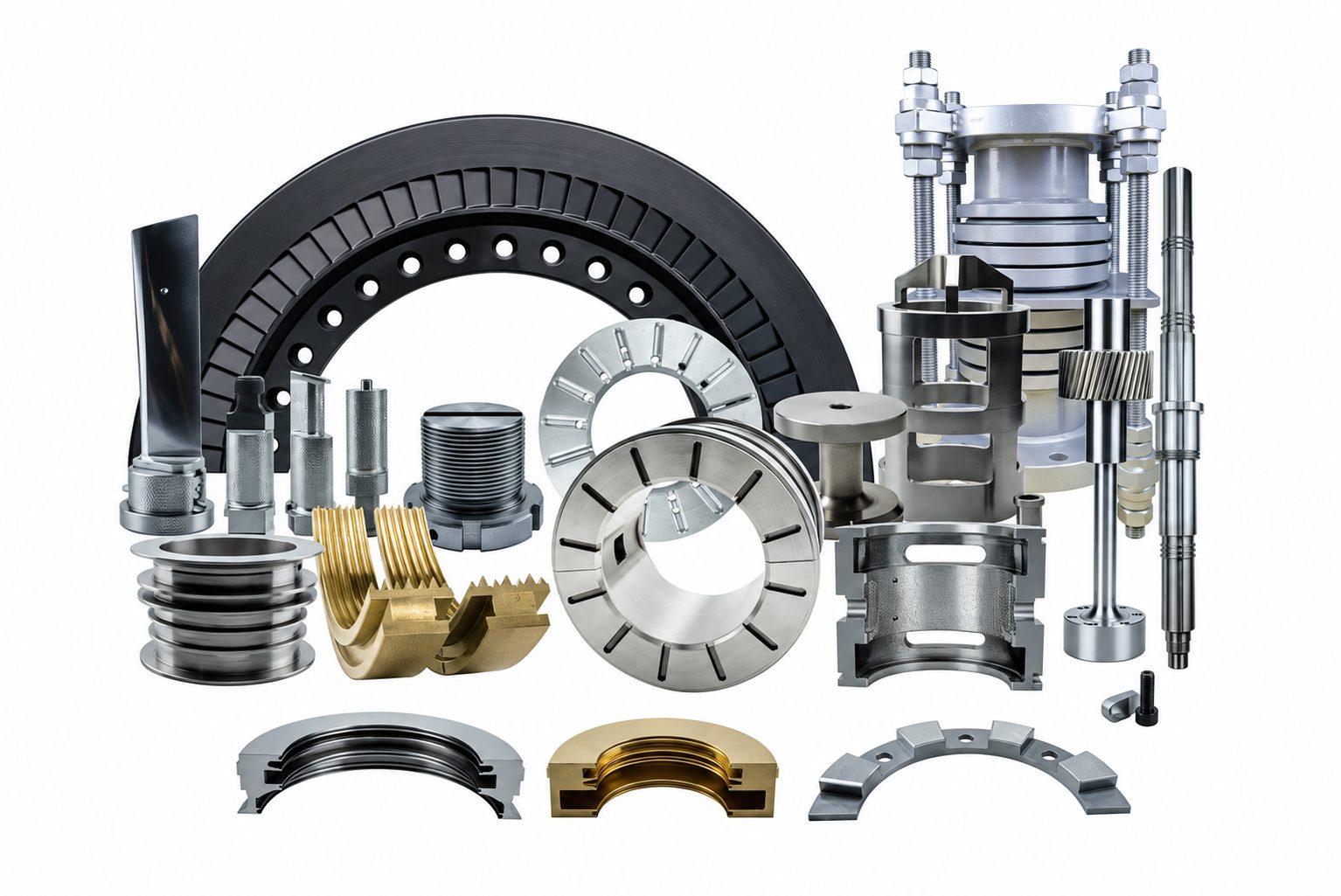
UNEW Industries manufactures the capital parts of steam turbines — the blading, rotor components, diaphragms, seals, bearings and valve internals of utility, industrial and mechanical-drive machines. Every part is produced from UNEW's own technical data, under a UNEW part number, to aviation standard, and meets or exceeds the OEM specification for the position it goes into.
Parts are supplied as complete stages or as single components, for the Siemens, GE, Mitsubishi, Toshiba, Fuji, Shanghai, Dongfang and Power Machines fleets and for industrial drive turbines of any make. Any part we do not yet hold is reverse engineered from a used sample.
| System | Components |
|---|---|
| Rotating blades | Impulse and reaction blades for all stages — HP, IP and LP — including free-standing and shrouded designs, twisted and tapered last-stage blades, with T-root, fir-tree, straddle, pinned and dovetail roots |
| Blade hardware | Integral and riveted tip shrouds, tip cover segments, retaining and lock strips, lacing wire and lashing lugs, closing pieces, pins, keys and lock wire |
| Rotor components | Wheels and discs, shrunk-on and built-up wheel sets, shafts and shaft ends, couplings, thrust collars, balance pistons; complete rotors quoted on request |
| Stationary steam path | Diaphragms — welded, cast and machined; nozzle blocks and nozzle rings; stationary blades and blade carriers; inner casings and shroud rings |
| Seals and glands | Labyrinth and spring-backed gland segments, interstage and tip seals, seal strips and caulking wire, brush seals, gland packing |
| Bearings | Journal and thrust bearings, tilting pads and pad carriers, bearing liners, oil deflectors |
| Valve internals | Stop, control, reheat and intercept valve stems, seats, discs, plugs, cages, bushings and strainers; governor and trip valve components |
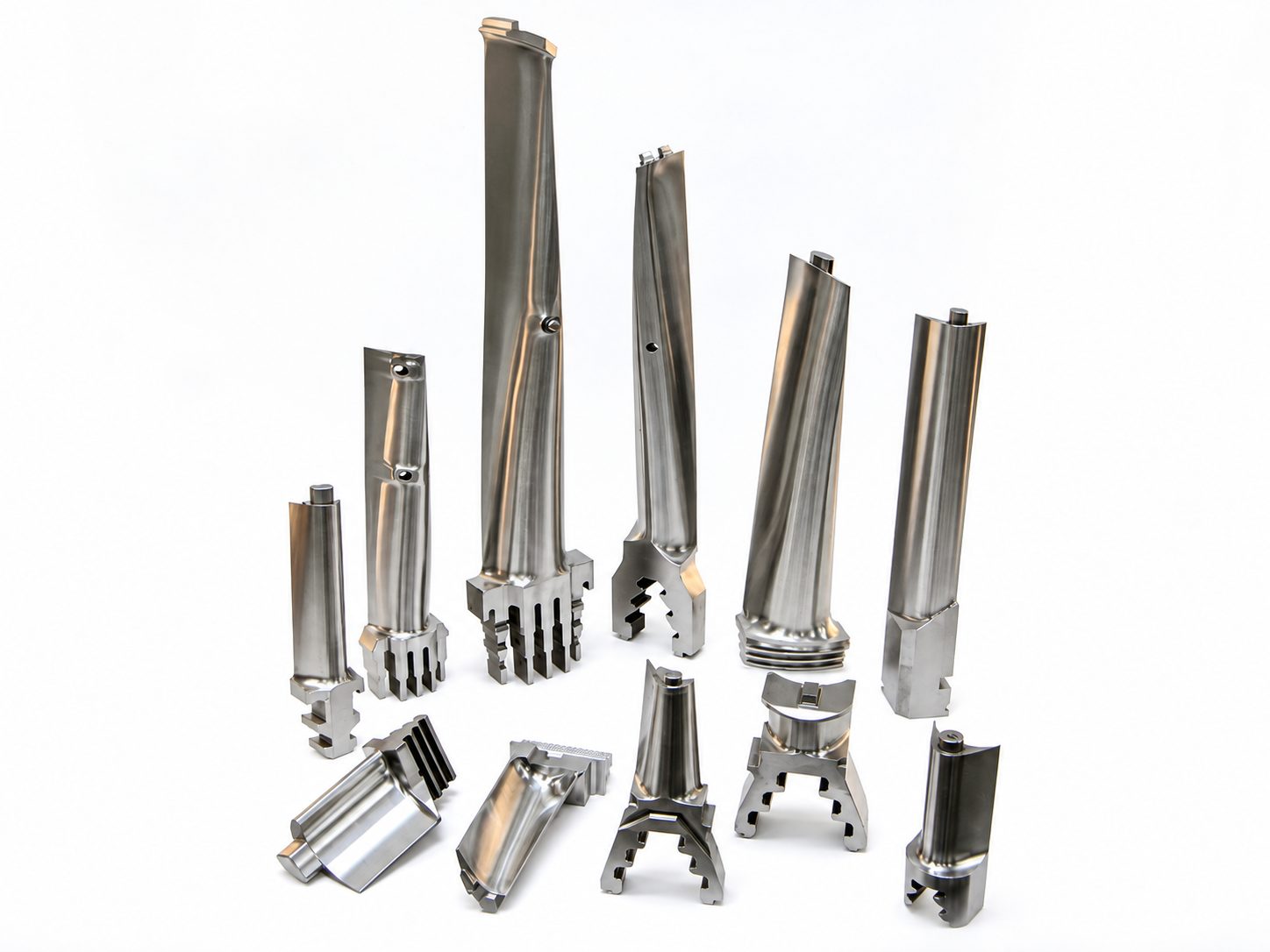
Each part is produced by the process the design calls for. The routing is fixed in the UNEW technical package and is the same on every repeat order.
| Technology | Application |
|---|---|
| Forging and bar stock | Closed-die and upset forging of blades in 12% chromium and precipitation-hardening steels and titanium; forged bar for smaller blades; ring, disc and shaft forgings in CrMoV and NiCrMoV steels |
| Precision machining | 5-axis milling of airfoils, platforms and shrouds from solid; creep-feed grinding and broaching of T-roots, fir-trees and straddle roots; CNC turning of wheels, discs, shafts and seal rings |
| Blade tuning | Natural-frequency measurement of every blade against the unit's speed range; frequency adjustment by controlled machining; moment weighing and set distribution |
| Fabrication | Welded diaphragm construction with blades set in inner and outer rings; machining of steam-path profiles after welding and stress relief |
| Erosion protection | Brazed or laser-clad Stellite erosion shields on last-stage leading edges; flame and induction hardening; boride and chrome diffusion treatments |
| Hardfacing and surface treatment | Stellite hardfacing of valve seats and discs, seal lands and lock strips; nitriding of valve stems and bushings; chrome plating of journals and seal areas |
| Heat treatment | Quench and temper, precipitation hardening and stress relief in controlled furnaces, with furnace charts retained for each serial |
| Balancing | Low-speed and high-speed dynamic balancing of wheels and complete rotors; overspeed testing to the unit's trip speed |
| Inspection | CMM and 3D optical scanning, magnetic particle, fluorescent penetrant and ultrasonic examination, hardness and metallurgical evaluation, natural-frequency testing and moment weighing |
Base materials are selected for the position — stage, steam temperature and steam quality — not for the catalog. Where an OEM has upgraded a position over the life of the machine, we supply the upgraded grade.
| Component | Base material | Why |
|---|---|---|
| HP and IP blades | X22CrMoV12-1 (1.4923), X20Cr13, AISI 403 / 422, 12CrMoV and Jethete M152 | Creep strength and corrosion resistance at high steam temperature; 12% chromium steels for weld repairability and oxidation resistance |
| LP and last-stage blades | 17-4PH, X5CrNiCuNb16-4, AISI 403; Ti-6Al-4V for long last-stage blades | Fatigue strength and erosion resistance in wet steam; titanium where blade length and centrifugal load call for low density |
| Shrouds, cover segments, lock strips, lock wire | Type 403 / 410 / 321 / 316 stainless steel to match the blade row and steam temperature | Compatibility with the blade material and formability for peening and caulking |
| Wheels, discs, shafts | AISI 4340, 26NiCrMoV14-5, 30CrMoNiV5-11 and equivalent CrMoV and NiCrMoV forgings | Fracture toughness and low-cycle-fatigue life at bore, keyway and root; creep resistance for HP shafts |
| Diaphragms, nozzle blocks | 12% chromium blades in carbon-steel or CrMo rings; cast 13% chromium steel; CrMoV for HP stages | Weldability of the ring assembly with creep resistance of the blade profile |
| Seals and glands | 12% chromium steel, nickel-copper and leaded bronze; nickel-base alloys for HP glands | Wear compatibility with the rotor without damaging the shaft on rub |
| Bearings | Steel or bronze shells with tin-base babbitt | Embeddability and conformability of the babbitt with load capacity of the shell |
| Valve internals | X22CrMoV12-1, X20Cr13, CrMoV and 17-4PH | Creep strength and erosion resistance in high-velocity steam; hardfaced seats and discs for tight shut-off |
| Treatment | Process | Where it is applied |
|---|---|---|
| Erosion shield | Brazed or laser-clad Stellite 6 / 6B | Leading edges of last-stage and next-to-last-stage LP blades |
| Hardfacing | Stellite overlay, laser cladding, HVOF carbide | Valve seats and discs, seal lands, shroud contact faces, lock strips |
| Diffusion treatments | Nitriding, boride and chrome diffusion | Valve stems and bushings, blade roots and platforms in wet-steam stages |
| Journal restoration | Weld build-up, chrome plating, HVOF coating | Bearing journals, seal areas and coupling fits on rotors and shafts |
| Shot peening | Controlled shot peening | Blade roots, wheel dovetails and stress-concentrating fillets |
Hardfacing and cladding thickness, bond and microstructure are verified on witness coupons processed with each batch, and the coupon record travels with the parts.
Aviation standard, steam turbine design. Machining, surface-treatment, balancing and inspection processes are those of our aviation workshop, applied to steam turbine parts. The tolerances and acceptance criteria are tighter than the OEM's industrial specification.
Meets or exceeds OEM specification. Every part is qualified against the OEM position by a documented technical comparison — dimensions, material, surface treatment, frequency and moment weight — before release.
Partial replacement. Because we hold the exact geometry of the part, the damaged blades of a row are manufactured to fit the shroud and wheel already on the rotor. Operators are not obliged to buy a complete stage to replace a few blades.
Interchangeable with the installed set. UNEW blades fit alongside OEM blades in the same row, tuned to the same frequency band and moment-weight class, with roots ground to the existing wheel.
Frequency-verified. Every blade is tested and its natural frequencies recorded against the unit's operating speed range, so a new row goes back into service without a resonance risk.
Serialized and traceable. Every part carries a UNEW serial number traceable to heat, forging lot, treatment batch and inspection record, from raw material to delivery.
Held in inventory. We maintain a minimum of one spare set for every model we support, so a failed row does not wait for a production slot.
Reverse engineering is how a new part enters production — for any make and model. A used blade, shroud, seal or valve internal removed at an inspection is all we need; the sample is returned after engineering. The result is a complete technical package held by UNEW Industries, from which the part is manufactured as a UNEW product on every order thereafter.
| Step | What we do |
|---|---|
| 1. Dimensional capture | 3D optical scanning and CMM measurement of the complete part — airfoil, root, tip, tenons, shroud and sealing features; measured wear and erosion are corrected back to the design condition |
| 2. Material analysis | Chemical composition, hardness, microstructure and heat-treatment condition of the base material; identification of erosion shields, hardfacing and diffusion treatments |
| 3. Design verification | Natural-frequency and moment-weight baseline of the sample blade against the unit's speed range; throat and profile baseline for nozzles and diaphragms |
| 4. Engineering | Manufacturing drawings, forging or bar-stock definition, material and surface-treatment specifications, machining and process routing, frequency tuning basis, inspection plan and acceptance criteria |
| 5. First article | Manufacture and full first-article inspection against the engineered data; frequency testing and moment weighing; metallurgical sectioning of a first-article coupon |
| 6. Release | UNEW part number assigned; the part enters our library and is manufactured to the same data on every repeat order |
Each delivery is supplied with a certificate of conformance, material certificate to the heat, dimensional record, NDE record, surface-treatment record with coupon results, and for blades the frequency and moment-weight record with set distribution. Parts are identified by UNEW part number with cross-reference to the OEM part number, stage and installation position.
UNEW Industries operates an ISO 9001 quality management system. Every part is traceable by serial number from raw material to delivery.
2570 N. First Street, Second Floor, San Jose, CA 95131, USA
Tel. +1-408-892-2364