- Home
- Extruders and Pelletizers
- Case Study: JSW CMP Reverse Engineering
Reverse Engineering the Full Capital-Parts Scope of JSW CMP Extruders
From a single worn part to complete control of the technology

From a single worn part to complete control of the technology
| Customer | A polyolefin producer on the US Gulf Coast — polyolefin production and compounding at three sites |
|---|---|
| Application | Compounding and underwater pelletizing of Polypropylene (PP), High-Density Polyethylene (HDPE) and Linear Low-Density Polyethylene (LLDPE) |
| Machinery | JSW CMP Series twin-screw extruders — CMP308, CMP335, CMP362 and CMP443 — each paired with a JSW ADC underwater pelletizer |
| Scope | Twin screw shafts, screw elements, barrels, die plates, pelletizer knives, bearing bushes, couplings and mechanical sealing |
| Service | Reverse engineering, new manufacture, refurbishment and life-cycle parts supply |
| Starting point | No drawings, no material specifications, no design data, no OEM support |
| Result | Complete manufacturing control of the full capital-parts scope across all four machines |
A polyolefin producer on the US Gulf Coast makes PP, HDPE and LLDPE at refinery-integrated complexes. Compounding and pelletizing capacity runs on four JSW CMP Series twin-screw extruders — CMP308, CMP335, CMP362 and CMP443 — each coupled to a JSW ADC underwater pelletizer. These machines are the bottleneck of each line: when one stops, the resin line behind it stops with it.
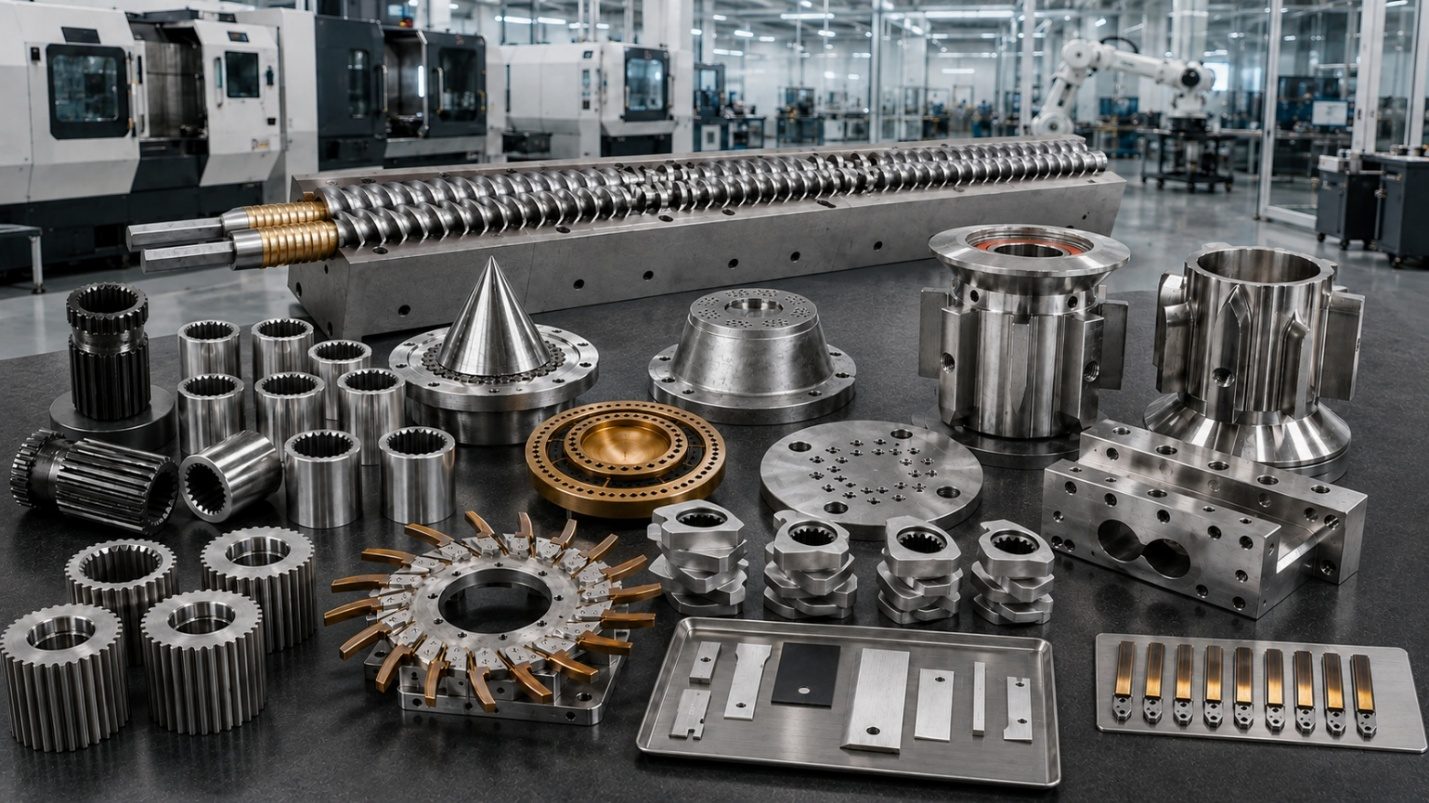
UNEW Industries reverse engineered the complete capital-parts scope for these machines and now manufactures every part in it — twin screw shafts, screw elements, barrels, die plates, pelletizer knives, bearing bushes, couplings and mechanical sealing. We began with worn parts and nothing else: no drawings, no material specifications, no design data and no support from the original equipment manufacturer. Part by part, machine by machine, we rebuilt the technology until we held all of it.
Today the producer no longer depends on a single source for the parts that keep its polyolefin lines running, and UNEW Industries holds the full technical data set for the JSW CMP and ADC platforms in its own hands.
The machines had been in continuous service for many years on abrasive, filled and high-throughput polyolefin duty. Screw elements and barrels were worn beyond service clearance, die plates had lost face flatness and nozzle geometry, and the shafts were approaching the end of their useful life. The plant faced a familiar set of constraints:
Original spares were available from one source only, at long lead times, with several part numbers superseded or no longer produced.
No drawings, no material certificates and no design data were in the customer’s possession, and none could be obtained.
A single unplanned outage on one line costs far more than the entire annual parts budget for that machine.
A wrong non-original part does not simply fail — it takes the barrel bore, the shafts or the die face with it, and those are the most expensive assemblies on the machine.
Screw geometry and wear behavior differ between PP, HDPE and LLDPE service, so one generic part set would not serve all four machines.
The producer needed a second source able to reproduce capital parts to original fit, function and service life — without a single drawing to work from. That is the problem UNEW Industries set out to solve.
We started with one worn twin screw shaft set and one used barrel section. Nothing accompanied them: no drawing, no specification, no material certificate, no assembly data. Every dimension, every fit, every alloy and every heat treatment had to be recovered from the metal itself.
Worn parts do not hand over their original geometry. A screw element that has run for years in filled PP has lost flight land, crest and root; a barrel has lost bore and gained ovality; a die face has been ground back and re-lapped. Reverse engineering a worn part means separating the design from the damage — reconstructing what the part was when it left the factory, not copying what erosion left behind. That is the discipline the whole program was built on.
The complete capital-parts scope for the CMP extruders and ADC pelletizers is now manufactured by UNEW Industries:
| # | Part | Technology recovered | Supply today |
|---|---|---|---|
| 1 | Twin screw shafts | Spline system and torque path, journal and seal fits, straightness, runout and matched-pair tolerances, core material and nitriding specification | New manufacture in matched pairs; refurbishment |
| 2 | Screw elements | Conveying, kneading and mixing element geometry — pitch, lobe count, helix angle, land width — and the element stacking sequences used for PP, HDPE and LLDPE | New manufacture, element by element or as complete configured screw sets |
| 3 | Barrels | Bore geometry and center distance, feed pocket and vent port arrangement, cooling bore layout, nitride and bimetallic liner specification, flange and tie-rod interfaces | Feed, vent and closed barrels; single sections or complete matched barrel trains |
| 4 | Die plate | Nozzle pattern, diameter and taper, melt channel and heating arrangement, thermal insulation, face flatness and hard faced or carbide-inserted cutting face | New manufacture; resurfacing and re-nozzling |
| 5 | Pelletizer knife | Blade profile and cutting angle, hub interface, blade count and material grade, matched to die face geometry | New knife sets; regrind to original profile |
| 6 | Bearing bush | Journal and thrust bush geometry, clearance and fit schedules, bearing material specification | New manufacture to original clearance or fitted to housing |
| 7 | Coupling | Screw-to-gearbox spline adapter geometry, torque rating and fit | New manufacture to original fit and rating |
| 8 | Mechanical sealing | Seal face geometry and material pairing, seal housing, flush and water-chamber arrangement | Complete cartridges; replacement faces and elastomers |
All four extruders — CMP308, CMP335, CMP362 and CMP443 — each with its JSW ADC underwater pelletizer, are covered to the full capital-parts scope in PP, HDPE and LLDPE service. The three resins do not wear a machine the same way, so element geometry, wear packages and material grades are selected per machine and per resin campaign rather than applied as one generic set.
| Application | Material specification in production |
|---|---|
| Shafts and couplings | 1.8519 / 42CrMo, through-hardened and nitrided |
| Screw elements — general compounding | Hot-work tool steel 1.2343, nitrided |
| Screw elements — abrasive and filled PP | Powder-metallurgy high-alloy tool steel, HIP consolidated |
| Flight lands — severe wear positions | Nickel-base hardfacing (NIKRO 128 class) and tungsten-carbide overlay |
| Barrels — general compounding | Nitriding steel 1.8550 / 34CrAlNi7, gas nitrided bore |
| Barrels — abrasive and corrosive service | Centrifugally cast bimetallic bore, iron-base or nickel-base carbide alloy |
| Die plates and cutting faces | Tool steel with hardfaced or carbide-inserted face; 17-4 PH where corrosion applies |
| Pelletizer knives | Hardened tool steel, martensitic stainless and carbide-tipped grades |
| Wetted and corrosive-service parts | 12Cr13, 316 / 316L and other corrosion-resistant grades |
| Bearing bushes | Bearing bronze, 42CrMo and hardened steel |
Every delivery is supplied with full material traceability and mill certificates; composition, hardness, case depth, liner and coating thickness and final dimensions are recorded and certified with each part and each matched set.
The program was deliberately staged. We earned the next part by proving the last one.
| Stage | Scope taken on | What it proved |
|---|---|---|
| Stage 1 | Pelletizer knives and bearing bushes | Lowest-risk consumables. Established the metrology, material analysis and inspection method, and delivered parts the plant could try without exposing a capital assembly. |
| Stage 2 | Screw elements and die plates | The wear-critical geometry. Proved that recovered element and nozzle geometry produced the same melt behavior, pellet shape and cut quality as the original parts. |
| Stage 3 | Twin screw shafts, couplings and mechanical sealing | The torque path. Proved spline reconstruction, matched-pair manufacture, fit schedules and sealing performance under full load. |
| Stage 4 | Barrels — feed, vent and closed — and complete barrel trains | The heaviest capital assembly. Proved bore, center distance, liner technology and train-level dimensional coordination across the machine. |
| Stage 5 | Full scope across CMP308, CMP335, CMP362 and CMP443 with ADC pelletizers | Total control. One supplier, one data set, one interface — every capital part on every machine, coordinated as a package. |
| Measure | Before | After |
|---|---|---|
| Source of supply | Single source, no alternative | Second source qualified for the entire capital-parts scope |
| Technical data | None held by the plant, none obtainable | Complete reconstructed data set held and maintained by UNEW Industries |
| Lead time | Long OEM lead times, quoted per part | Substantially shortened; repeat parts made from held data |
| Obsolete part numbers | Superseded or discontinued items unavailable | Reproduced by reverse engineering, including out-of-production designs |
| Part life | As originally specified | Equal or longer — upgraded wear materials routinely outlast the original where the original alloy was under-specified for the duty |
| Parts strategy | Reactive, part-by-part replacement | Planned: condition survey, refurbishment where viable, new manufacture where not |
| Cost basis | OEM list pricing | Lower, with refurbishment available at a fraction of new-part cost |
UNEW Industries holds the complete technical data set for the JSW CMP platform — CMP308, CMP335, CMP362 and CMP443 — and for the ADC underwater pelletizers that run with them. Shaft and spline systems, screw element and kneading block geometry, barrel bore and center distance, die and cutting-face arrangements, sealing and bearing interfaces, and the wear mechanisms that limit part life on these machines are all documented in our own records.
This is why we never ask a customer for drawings, datasheets or technical data. We already hold the technology, and where we do not yet hold it, we reverse engineer it — as we did here, from a single worn part.
The same program is applied to any extruder or pelletizer platform, of any make, model or age, including obsolete and out-of-production equipment. The machine make and model are sufficient to open a project.
UNEW Industries operates an ISO 9001 quality management system. Every part is traceable by serial number from raw material to delivery.
2570 N. First Street, Second Floor, San Jose, CA 95131, USA
Tel. +1-408-892-2364